Talos Adds NEAR Intents Liquidity to Institutional Trading
Talos integrated NEAR Intents on November 9, bringing cross-chain quotes into its trading workflow. Custody approval and access conditions still matter.
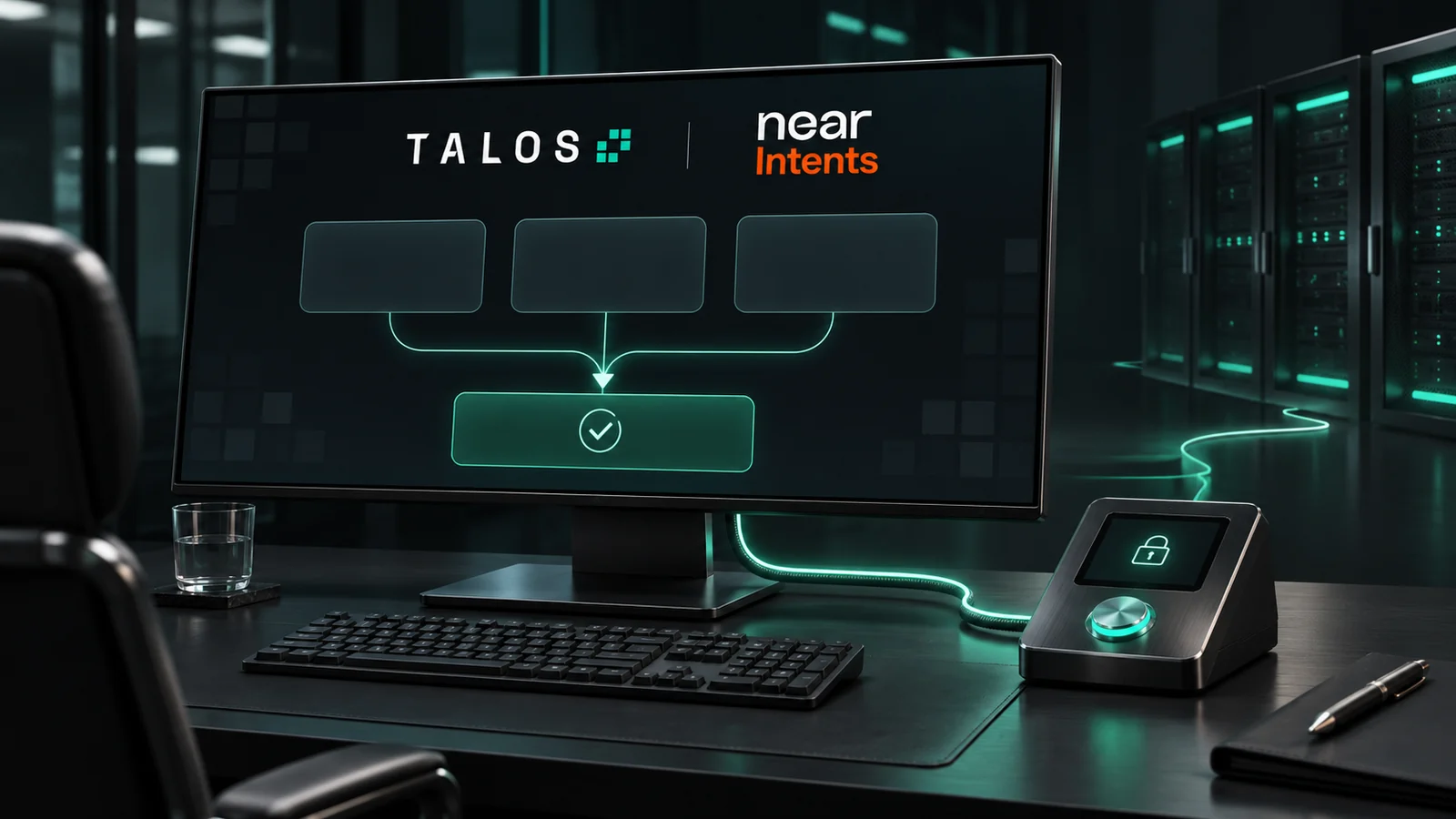
Talos added NEAR Intents to its institutional trading platform on November 9, 2026, allowing clients to request cross-chain swap quotes through their existing order and execution workflow. The integration brings a network of competing liquidity providers into a system already used by trading desks, with transactions signed through clients’ custody relationships.
The operational change is the story: a desk can reach another source of liquidity without building a separate trading process around it. The announcements do not establish universal custodian compatibility or identical access for every institution.
Competing quotes enter the trading desk’s workflow
In its November 9 announcement, NEAR says the integration is live inside Talos’s Order and Execution Management System. Liquidity providers known as solvers compete to satisfy a requested exchange, drawing on blockchain and centralized trading venues. The model differs from a trader interacting with a single liquidity pool: the solver takes responsibility for sourcing the inventory needed to fulfil its quote.
NEAR says fungible tokens are supported now, while tokenized real-world assets, yield-bearing assets and prediction markets are planned additions. Those future instruments should therefore be kept separate from the capabilities available at launch.
For a trading operation, the potential benefit is a wider set of quotes within an established process. Competition alone does not demonstrate that a particular order receives the best available result. That requires comparing executable terms for the same size, assets and destination.
Custodian signing remains a separate control
Talos’s launch release describes a delegated signing service. After a quote is accepted, its software prepares an intent message, sends it to the client’s custodian for approval and signature, then submits the signed message for execution. Talos describes the signing layer as custodian-agnostic, but also says wider custodian rollout is ahead.
This distinction matters for an institution with established approval rules. Expressing a desired trade and authorizing the assets needed to settle it are different responsibilities. Keeping them in a familiar interface could reduce operational friction; it does not remove the need to establish which custody connections and approval policies actually apply.
Talos also says resulting positions appear within the client’s consolidated portfolio view. In practical terms, execution and record-keeping need to agree. A desk must be able to identify what was filled, what remains pending and which balances belong in its books.
A simpler interface still has underlying dependencies
Cross-chain execution continues to rely on infrastructure beneath the quote. The NEAR Intents documentation for Omni Bridge distinguishes message relayers from the operators that jointly produce withdrawal signatures. It also describes different verification methods across chains and identifies other bridges used for some Intents routes.
That documentation explains why removing manual bridge management from the trading desk does not remove bridge dependencies. A route’s operational assumptions still matter even when the interface presents one accepted price. Institutions evaluating the connection need to understand the infrastructure relevant to their actual assets, rather than treating every supported network as interchangeable.
The same separation applies to costs. NEAR describes volume-tiered commercial fees, with details supplied during onboarding. A low network charge is not a complete trading fee schedule. GhostSwap’s earlier report on NEAR Mobile’s gas sponsorship examines the related distinction between simplifying a gas payment and eliminating the cost of a swap.
Access terms define the launch’s reach
Talos’s release states that clients negotiate their own arrangements with liquidity providers and other parties, and that services and venues may be unavailable in some jurisdictions. The integration supplies connectivity; the necessary commercial relationships and eligibility remain separate.
For example, a firm may see value in adding another source of stablecoin quotes while still needing a supported receiving network and reconciled settlement records. GhostSwap’s coverage of Polygon’s Solana payments expansion shows how a unified workflow can encompass several distinct stages with their own completion conditions.
The November 9 launch puts solver-based liquidity closer to an institutional trader’s existing controls. Its usefulness will depend on the available quotes, supported custody arrangements and reliable records for each completed trade.